Photo Credit: Freepik
Death at the Altar
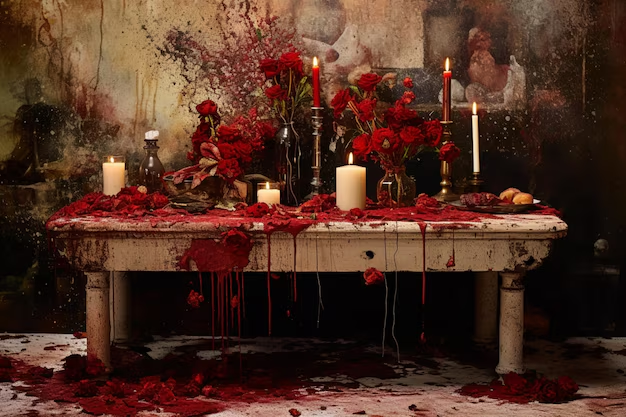
Father Patrick was shot while at the altar, on the eve of Easter Sunday. He had stood at the altar, hands trembling slightly as he reached for the chalice. Having just begun the sacred call, pleading for the alchemy that transforms wine into blood. Then a single crack echoed through the hushed cathedral. Then the chalice spilled across the pristine white altar cloth, blooming outward like a dark velvet stain and mixed with his blood a premature mimicry of the same miracle he had invoked. The congregation remained frozen, transitioning from liturgy to tragedy. It happened so fast and so swift that the incense still curled lazily through the air, the alter-boy still holding the thurible tightly oblivious to the fact that Father Patrick was about to offer his own life in the place of the blood of Jesus.
The silence remained for about two seconds before a scream came from the side where the choir members sat, then from the C.W.A section. It was though the church itself had for a moment refused to understand what it had witnessed and left it for the stained-glass images of saints Peter, and Paul and Benedict and Francis Xavier to watch in astonishment. Then the sound returned all at once. At first it was the sharp gasp of a woman in the front pew, then the metallic clang of the thurible striking the marble floor and immediately the altar carpet was burning. And the smell of charred fabric settled into the incense indistinguishable. Then there was the rising swell of panic that broke the hush into fragments. Then catechist Florian rushed forward, he knelt as if in prayer, his hands trembling and he began pressing against Father Patrick’s wound that bloomed beneath the priest’s vestments. The masked man with the gun walked to the pulpit. His rifle now hanging across his shoulder, he removed his mask and immediately the church recognized him and in collective gasp they called: KOMBO!
They had called out on the name as though they were testing whether it still belonged to the boy. A boy who had once served mass alongside Father Patrick as an altar boy. It did. That was the problem. At the pulpit twenty three year old Kombo, stood looking like a ceremonial figure, perhaps feeling like Patrice Lumumba waiting to read the independence speech or the Grammy’s host waiting to announce the album of the year. His breathing was visible in the slight rise of his shoulders. The rifle looked even heavier than it had a moment ago. Without the disguise, there was no spectacle left, only a young man who once was ambitious and holy standing still before a dying white Belgian priest. The priest made a sound which was less a groan than an interruption of breath. Catechist Florian pressed even harder against the wound, his fingers slick, his lips moving but no prayer forming properly. Blood now soaked through the embroidered chasuble and spread in irregular veins across the marble floor, finding the shallow grooves between the tiles.
‘I asked you once if it was sin,’ Kombo said looking at Father Patrick’s fluttering eyelids. Recognition passed slowly across his features the way dawn arrives reluctantly. His lips parted. It took effort, more effort that he usually had taken when calling African names trying to remain connected with the local people, as he claimed. Speaking Lingala and calling Africans not by their Christian names but ancestral names made him feel less of a stranger, it gave him the sense of belonging of being one with his parishioners at St. Jude Cathedral in Goma.
‘Kombo,’ Father Patrick acknowledged.
Kombo’s mouth tightened. ‘Wasn’t you the one that said obedience is purity, Father?’ His voice was steady now and somehow oddly conversational. ‘You said doubt was the devil speaking.’ A murmur was now rippling through the pews, people wanting to understand what all this was about, it then died shortly as it had started. The church choir sat rigid, their hymn books still clutched tightly in their hands.
Father Patrick shifted faintly under Catechist Florian’s hands. A soft cough forced blood from the corner of his mouth. It surprised him. He blinked at it as though the body’s betrayal was a minor inconvenience. Catechist Florian gathered his courage and looked into Kombo’s eyes, his expression breaking open. ‘This is not the way son,’ he said. Kombo snubbed, ‘Father Patrick chose me because I was a quiet child and because my family trusted him.’
There was something raw enough that even the pews seemed to absorb it. Kombo’s mother who was also present at the mass sat very still with her eyes fixed on her son and in them was something worse than disbelief, her comprehension arriving too late. Father Patrick swallowed and the movement hurt him. It was very evident. His hands twitched upward instinctively toward the crucifix above the altar. It did not reach far as it suddenly collapsed.
‘Lambisa ngai,’ he whispered,’ forgive me in Lingala.
Kombo gave a small shake of his head simply refusing the direction of the sentence. He lowered the rifle to the floor. Stepped closer and pretended to genuflect just enough to meet Father Patrick’s eyes without looking down. ‘I’ve lived with much pain, I tried to confess what you did as if it were mine.’ Father Patrick’s gaze shifted but still stayed on Kombo and in there he found clarity that had not been present before. Pain had stripped away performance. What remained was even smaller. Humans.
His breathing shortened with each inhale failing to complete. His fingers flexed once against the marble catching briefly on the edge of the altar cloth. The gold embroidery on his white chasuble near his shoulder had darkened to brown. The church had for once remained a gallery of hostages, to the gunman Kombo. They had patiently waited for the events to unravel themselves and they remained witnesses.
According to Kombo allegations, Saint Jude through the white priest had defied its narrative of divine benevolence, and had failed to offer the sanctuary it promised in the brochures of the Goma Children’s Advancement Fund, (GCAF). Father Patrick had arrived in Goma at twenty-eight years of age, a newly ordained priest from Brussels; among the priests sent for mission work in Africa. His stated intention had been to promote literacy and support vulnerable children to higher education through his study abroad program. He established a fund that generated revenue through the community initiatives, albeit, a higher percentage came from grant proposals sent to governments and donors in Brussels and in America and in Germany. But this was merely what people were led to believe. He had successfully, and without question sold the narrative of African poverty – a continent in dire need of charity and western aid.
While it cannot be denied that he helped some young parishioners at St. Jude climb to Ivy league universities, including the Parish moderator Dr. Mukarinia and Ms. Mildred the C.W.A Chairlady who was also a judge, albeit, these successes were overshadowed by trauma of boys like Kombo. Father Patrick had often inhibited their very skin and convinced them it would be a sin to speak of what he had done. After all, Kombo’s mother had often cautioned him of not talking ill of the God’s anointed one. And so, Father Patrick’s blood on the marble floor was heavy and indifferent to the holiness of the marble stained and to the blood of Christ, one that he invoked while he lifted the chalice.
The priest’s life was now a guttering candle. His breath wet and hitching gasps that seemed to struggle against the weight of the very air he once used to command the room. The mention of the Goma Children’s Advancement Fund, sparked a final desperate flicker of the administrator within. His hands stained dark with his own life twitched toward the altar, once more. He wanted to reach for the crucifix and take his last breath holding onto it, or it placed on his chest.
‘It was … for the mission,’ Father Patrick wheezed. The words were small pathetic things stripped of their resonance that they usually carried from the pulpit of a church that had convinced the parishioners that their presence was a holy necessity and a divine shield against the very poverty the church’s secular partners had helped create. Stripping the land of its value, extracted the gold and rubber and then returned a fraction of the profit and called it aid to the African people that required total spiritual submission. It was a closed loop of exploitation sanctified by the sign of the cross.
The congregants that had initially frozen by the sudden eruption of violence were now beginning to undergo a chemical change. Their fear was now replaced by a heavy atmospheric realization. ‘This is what they have been calling humanitarian aid!’ Kombo declared, the silence of the church acting as an amplifier. ‘They send us advisors and priests to ensure the soil remains ready for their harvest, they say bring your harvest to the lord wrapped in silk and so we do, singing and dancing to the melodies tunes; Yamba Yamba Yaweh eh! Yaweh! Yamba Yamba Yaweh eh!’ He murmured the song: We are told to look up to the heavens and that our hope comes from God, who made heaven and earth, whose silver and gold belongs to does this god live in America. Is this heaven they say, where they take our gold and coltan? Where does our hope come from; the aid? Why do we believe in their lies that to suffer is to be like Christ? Father Patrick here drives, and eats beacon for breakfast, he flies first class to Britain and America and Germany, he takes wine after dinner, “Wine is good for the stomach,” Kombo said as he held his nose tightly together and pretended to speak in the white priest’s accent.
He looked at the crucifix then back at the dying man. ‘But Christ was a revolutionary. He flipped the tables of the money-changers. You? You were just but a colonial administrator in a vestment trying to keep the ledger balanced. Christ said let the children come to me, it was not to molest them as you did.’ At that moment the cathedral had been stripped of its holiness and left behind only a stark fluorescent truth that only happened in places like a courtroom. It left the air thick with the scent of copper and that of old wax. Even the breathing of the dying priest at the altar seemed to hitch in the synchronization with the tension in the room. The holy spirit escaped only the weight of history whose time to pay had come.
‘Do you remember the night, while at the sacrist you told me that my silence was my greatest virtue much needed for a monastic life?’ Sundi inquired, he did not give time for response, ‘when you told me it was the path to the priesthood. You promised me that if I kept our little secret, you would recommend me for formation in Brussels. That I would finally fly out of Goma. That I would live life no one in my life has ever experienced. That I would return to a jovial community, whose son had chosen the path to holiness. That I would work among God’s people; the homeless, needy children, the sick of heart and body, the poor of spirit and soul, refugees and I wanted this to affirm their dignity, to assure them they are just as human as any other. But I feared I would turn out to be like you and abuse their vulnerability. I became unsure whether it was the stories you had sold me or was it a calling, and I figured out it wasn’t a calling. God’s calling must have come with certainty. Certainty and fulfilment of heart and soul, of body and mind.
‘You were right about one thing, Father. Secrecy was the currency of your entire empire. It’s how you bought your safety and it’s how the Fund bought our land, and how it in turn bought our silence. We were all just transactions of your ledger of grace.’
The sound of the first sirens began to wail in the distance signaling the approach of the uniform. The catechist realizing that Father Patrick was breathing his last he said a prayer. ‘ May Mary the holy mother of God, the angels and saints come to meet you Father, as you go forth from this life. May the crucified Christ bring you peace and may he remember his servant on the day of resurrection. May Christ who died for your sins admit you to purgatory and cleanse you and make you whole. May Christ the true shepherd, acknowledge you as one of his flock’ Then Father Patrick whispered his final breath, the catechist put the crucifix on his chest and continued with the final prayer. ‘Eternal rest granted unto Father Patrick, oh Lord and may the perpetual light shine upon him, may he rest in peace …’ only a few said Amen.
‘The world would think he died a martyr,’ Kombo said with his voice dropping low to an intimate tone that nonetheless reached the back of the cathedral. ‘Tomorrow, the headlines will mourn a Saint of Goma, they will write his name on a plaque of brass. They will send a delegate from the headquarters in Brussels to weep at your funeral and use your death to demand more funding to clean up the area. They will turn your corpse into a monument to hide the fact that you were just a man who fed onto the very people you claimed to save.’
Kombo then stood up, leaving the golden crucifix on the priest’s chest and Catechist Florian still holding to the wound hoping to bring his life back, wailing like a child hungry for their mother’s milk. The church doors had begun to rattle under the weight of the approaching authorities. Kombo passed by his mother, for a second a silent transmission passed between them a recognition that the gateway to heaven was closed but the door to the world was finally but violently open. Then Kombo stood in the center of the aisle and waited for the men in uniform to get him. He dropped his rifle. Put his hands high in a way that signified surrender and he dropped to his knees as one of the uniforms knocked him down.
Contributor’s Bio
Vundi Mwilu is an African writer and poet living in Nairobi, Kenya. His works have appeared in Phil Lit Journal, Mt. Kemya Times and Afrihill Press.. His fiction works explores themes on life and meaning, war and resistance, history and politics and decoloniality.