
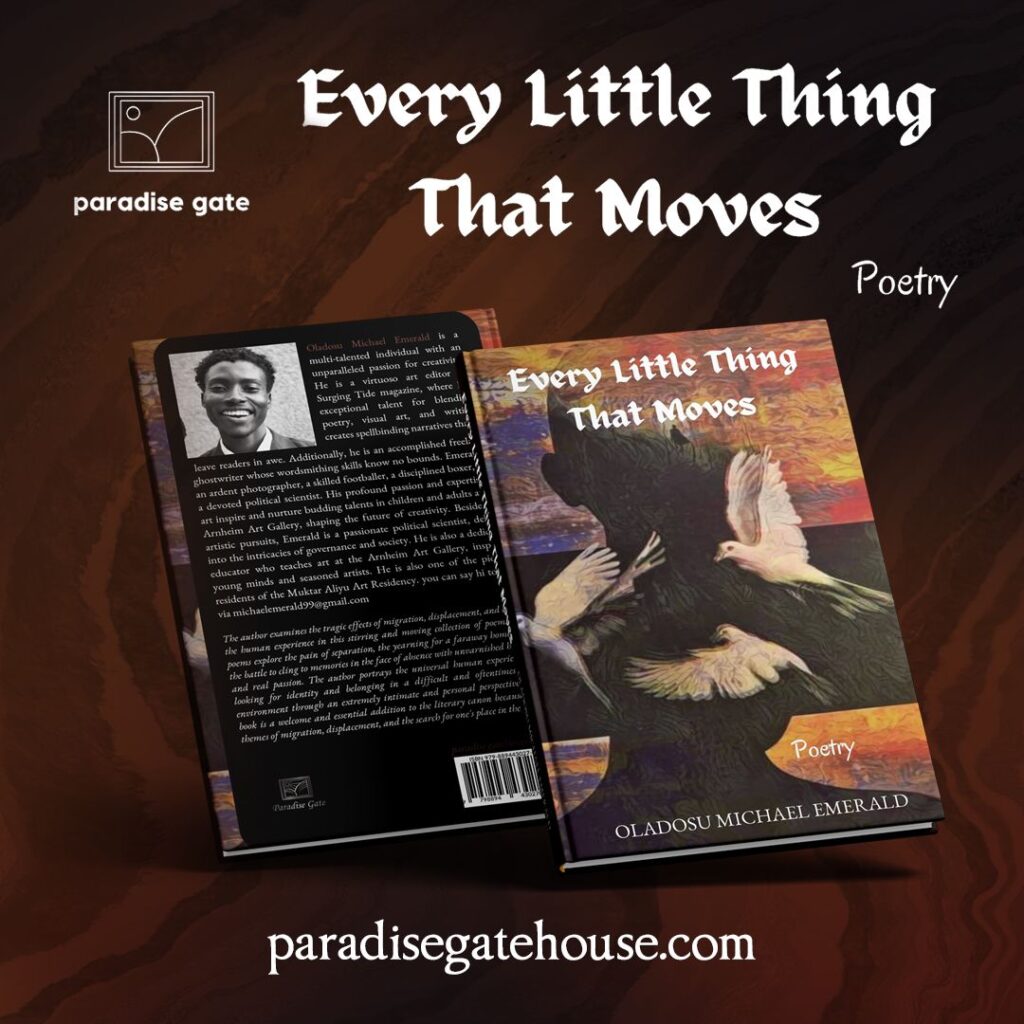
Photo Credit: Paradise Gate House
The Weight of What Moves Us: On Oladosu Michael Emerald’s Debut Poetry Collection
Language is not the content of thought but the vessel into which we pour the ambivalences and contradictions of our thinking, afloat on the current of feeling and time. When the vessel becomes too small to hold what we pour into it, language spills into poetry.
In this respect, poetry serves the same function as prayer: to give shape and voice to our unspoken and often unspeakable hopes, fears, and inner tremblings, the tenderest substance of our lives, to be held between the palms and passed from hand to compassionate hand. Poetry thus becomes an instrument of self-transcendence, an instrument that, in Niyi Osundare’s abiding words, “never forgets, and never ceases to remind the Future of its debt to the Past. For in its lyrical habitation lives our Lamp of Life.”
That function of poetry as the language of our lives is the spirit that moves through Oladosu Michael Emerald’s Every Little Thing That Moves, a collection where words stretch themselves to carry grief, hope, displacement, and the fragile gestures of survival. In these poems, language reaches for what ordinary speech cannot hold, becoming a vessel wide enough for memory, migration, and the strengthening pulse of being alive.
The collection opens on this note of emergence with “Exi(s)t”, a poem that moves like a slow resurrection. It is a poem of emergence—slow, deliberate, heavy with the weight of what the speaker carries. Lines like “I’ve learnt to unearth grief into memories” and “I was fathered by silence” reveal a voice that has matured through endurance. Emerald’s imagery is both mythic and intimate: the tortoise crawling out of water to sun itself is a stark metaphor for survival, for the stubborn will to keep living even when burdened.
The poem’s meditation on naming: “The vowel in your name means restoration”, shows the ways identity is preserved. In Oladosu’s hands, language becomes a site of both inheritance and resurrection. The parenthetical structure of Ex(i)st and Ex(i)t creates a visual echo of coming and going, suggesting that living is itself a form of leaving, and that the act of mourning is also an act of motion.
In “Migrant,” a shorter yet no less powerful poem, Emerald condenses the vast global narrative of displacement into seven concise lines. The poem writes migration not as a linear journey but as an ongoing negotiation with terrain; internal or external. The miracle of the Red Sea alludes to biblical deliverance, but Emerald complicates the triumph by reminding the reader that arrival does not guarantee belonging. The wave that midwifes the migrant’s entry also whispers rejection: “the shore / is not your home.” The tension between salvation and estrangement shows the migrant condition, the perpetual searching, and sometimes, the refusal of rest.
“When Home Became the Barrel of a Gun,” containing an echo of Fady Joudah’s humanist attentiveness, deepens this exploration of belonging. The poem begins with a canary nesting quietly in a garden, a delicate image that quickly becomes a metaphor. The father warns, “If you tear down the nest / it will know this isn’t a place / it can call home.” The speaker’s response, “Is that how people become refugees?”—is a small explosion. Oladosu Michael Emerald draws a line between the gentle displacement of a bird and the violent uprooting of people. The poem reads like a tender indictment: home becomes dangerous, not because one leaves, but because something pushes one out.
If displacement is the external fracture, “The Synonyms of Grief” is the internal register. Structured as a brutal litany, the poem presents grief as multiplicity: a cryptic poem, blades and Valium, a venomous snake, broken songs, thorns, bones wrapped in death’s cloak, a gallery of glass. The list form mirrors how grief repeats, mutates, and resurfaces in different shapes. Each synonym is a wound. Each line insists that grief is not singular, it is a devotion of pain that the body is forced to memorize.
The body, too, becomes a contested territory in “Body as a Metaphor.” Here, Emerald turns inward with a fierce spirituality. “My body is a flame,” he writes, a burnt offering, a Golgotha. The language is biblical, heavy with sacrifice and weariness. The body is both temple and battlefield, “a home that homes terror,” an ocean that can no longer bear its own ripples. The plea, “Lord, Moses me”—is a cry for deliverance, for a passage through waters that threaten to swallow. The poem holds both exhaustion and faith, a desire to be spared and renewed.
In “Bystander,” the poet confronts guilt and helplessness with startling honesty. A child drowns in a dream; the speaker watches from the bed, unable or unwilling to intervene. The refusal to seek interpretation—“Don’t interpret it to me. I know what it means.”—reveals a consciousness burdened by its own complicity. The poem mirrors the paralysis of witnessing suffering in real life, how people learn to observe tragedy rather than interrupt it.
Yet the collection is not without flickers of hope. “Dreams About Light and Fire” imagines destruction as a possibility. The explosion, the flame, the firework-like spread of brightness, these become metaphors for becoming. The speaker hopes the fire is not doom, but the beginning of self-illumination: “I hope it is my light / practicing to blow / for the world.” It is a rare moment of optimism, but one still wrapped in fear, as all hope tends to be.
Throughout the collection, movement becomes metaphor: grief moves, names move, bodies move, memory moves. Yet nothing moves freely. Everything is weighed by history, by silence, by loss. Oladosu Michael Emerald’s poetry honours this heaviness without drowning in it. His language is clean, controlled, and luminous, capturing the “melody in every thunderstorm,” the way pain can produce its own music.
Every Little Thing That Moves reads like a spiritual ledger, an accounting of what one loses, what one carries, and what one must leave behind to survive. Emerald speaks to the “migrants of life,” those who see the uncertainty not by choice but by necessity. His poems remind us that movement is both ache and anthem.
This collection marks Oladosu Michael Emerald as one of the younger voices in contemporary Nigerian poetry to read, and one especially attentive to the memory, the geometry of grief, and the quiet power of endurance. It is a book that moves, and moves you.
Contributor’s Bio
Esther Omoye is a graduate of the University of Benin. Her works have been published in Vanguard, Punocracy, One Black Boy Like That Review and others. When she’s not found singing to the chorus of Taylor Swift’s Cruel Summer, she can be found binge watching Kdramas.