
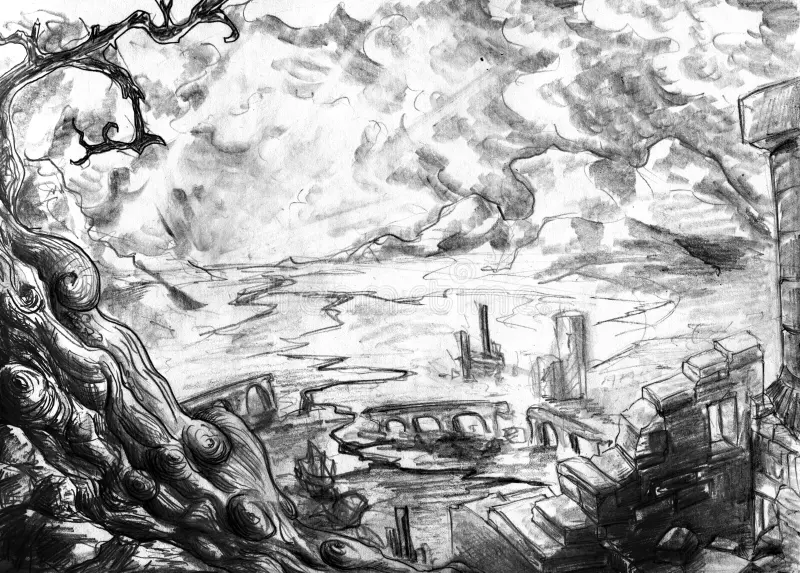
Photo Credit: ar.inspiredpencil.com
Fields Notes on a Country that Refuses to Remain Dead
Asma’u Yahaya Mustapha
Specimen I: Dust
Collected at 6:13 A.M. from the road between two unnamed towns. Composition: red earth, millet husk, tyre ash, the residue of feet traveling towards places they cannot afford to name. Under magnification, the specimen contains several extinct villages, three unfinished houses, a woman carrying water, and the outline of a border that was drawn before anyone living had been born.
Specimen II: Hunger
Found beneath the tongue of a child waiting outside a closed bakery. It has no measurable weight, although the body bends around it. When exposed to sunlight, it multiplies. When exposed to prayer, it becomes quieter, not smaller. Laboratory mice refused to approach it. The researcher did not.
Specimen III: Prayer
Recovered from the mosque after Maghrib. Transparent. Warm. No known point of origin. When held against the ear, it produces the sound of a mother calling someone who has already crossed the doorway. Attempts to preserve it in glass failed. By morning, the container was full of rain.
Specimen IV: Home
A disputed substance. Found in cooking smoke, the smell of wet clothes, the blue enamel of a forgotten bowl, the particular silence between a father’s cough and his refusal to complain. Every attempt to assign its coordinates resulted in migration.
Specimen V: Country
The specimen refuses classification. It changes shape according to who is looking: a flag under one microscope, a wound beneath another, a market at noon, a grave by evening. Its internal organs include borders, generators, prayers, unpaid salaries, abandoned roads, and the small stubborn mathematics by which mothers divide one pot of food among more mouths than it can hold.
Final observation:
At 18:42, the specimens began speaking to one another. Dust entered the prayer. Hunger entered the country. Home entered the body. The body entered the soil. The soil remembered everything except the name of the scientist who had come to measure it.
Conclusion:
No conclusion. The country is still changing under the glass.
Contributor’s Bio
Asma’u Yahaya Mustapha (penhusna) is a Nigerian poet. Her works have appeared or forthcoming in Ake Review, Brittle Paper, Kalahari Review, Eunioa Review and elsewhere. She is a longlistee of Joe Ushie Poetry Prize 2026.
So many emotions experimented in one single poem.
I had to go back to observe each specimen well before I understood the result.
Thought provoking it is!