
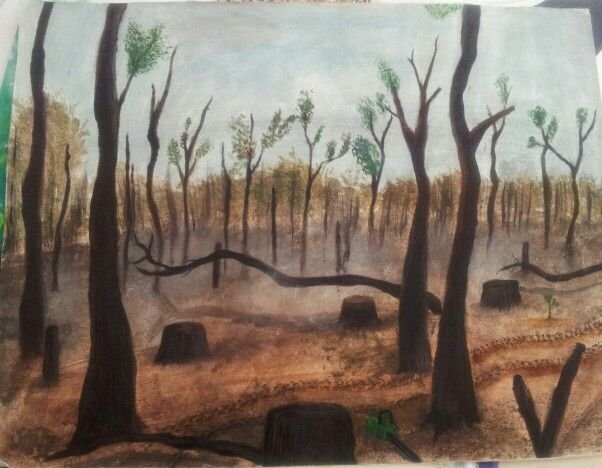
Photo Credit: narodnatribuna.info
The Trees Have Left Without Us
Hassan Ismail Adekunle
I wanted to write a poem,
but the page became another thing
I had to explain.
Outside,
a tree older than my grandfather
is being taught how to disappear.
Men arrive with machines
And the earth opens its mouth.
Nobody asks the tree
what it remembers,
Where its shadow gathered children,
glass and concrete rise
a forest with no birds.
A man from across the sea
greets an old woman:
Ẹ káàbọ̀.
He says it carefully,
like a key for a door
he never had to build.
Another ships our timber away,
singing hymns in Igbo
with workers who know
what his hands are taking.
Meanwhile, our people leave.
Toronto carries our laughter.
London carries our mothers’ prayers.
New York carries our slang.
Birmingham carries our stubbornness.
We fold Edo, Kalabari, Hausa, Yoruba
inside our luggage
and joke about colonising
the colonisers.
Perhaps we are only looking
for somewhere our children can breathe.
Back home,
Lagos swallows another morning.
Abuja grows taller than its poor.
Aba keeps working.
Kano keeps waiting.
Children dance beside generators
to songs whose meanings
even the adults have forgotten.
Someone is always leaving.
Someone is always arriving.
And somewhere between the two,
a tree falls.
No thunder.
No funeral.
Just the long, ordinary sound
of something ancient
meeting the ground.
I stand with my useless poem,
trying to remember
what the world looked like
before everything became
a place to build on.
The wind passes through the empty space.
For a moment,
I almost hear the trees.
Then a machine starts.
Contributor’s Bio
Hassan Ismail Adekunle is a Nigerian poet whose work explores contemporary Africa, identity, migration, memory, and the complexities of a changing world. His poems have appeared in Fivefleas, Synchronized Chaos, and other publications. He lives in Nigeria.


this is splendid. and metaphorically ingenious.
This is so beautiful and gut wrenching.
As I saw the title at first, I knew reading it was gonna give me goosebumps And it didn’t disappoint in doing that.
Great piece Babatunde(The coming of your grandpa perhaps).
Wow! this is amazing. A mixture of awareness and past happenings.
I love this so much. For a moment I hear the tree too!
And the trees have indeed left without us.
Keep writing Hassan.
Amazing piece.
Well written poet