Photo Credit: Paul Richardson/Bloomberg
Night Fall in Eko Atlantic by Olobo Ejile
It was my first visit to Eko Atlantic, a city which sits on the now extinct Bar Beach, the reclaimed land along the Atlantic Ocean Shoreline. The space, a couple of years back, was concessioned to South Energyx Nigeria Ltd, a subsidiary of The Chagoury Group. This earned the company the right to address the coastal erosion, reclaim, and create usable land around the coastline. “Speculations” suggest that Gilbert Chagoury, the all-time Lebanese-Nigerian who owns “grand properties” in the heart of Lagos, is a close ally of a Nigerian political rAScAL. What led me to this city, where, for certain, the poor would never live, was a children’s book and arts festival. This inspiring event was dedicated to Children’s Literature and Arts. As a volunteer, the day was interestingly burdensome due to the influx of attendees, as well as the simultaneous activities happening. These were: book readings, book signings, buying and selling of educational materials, games, STEM activities, sip and paint, knitting, award dedication, feasting, and a long list of others.
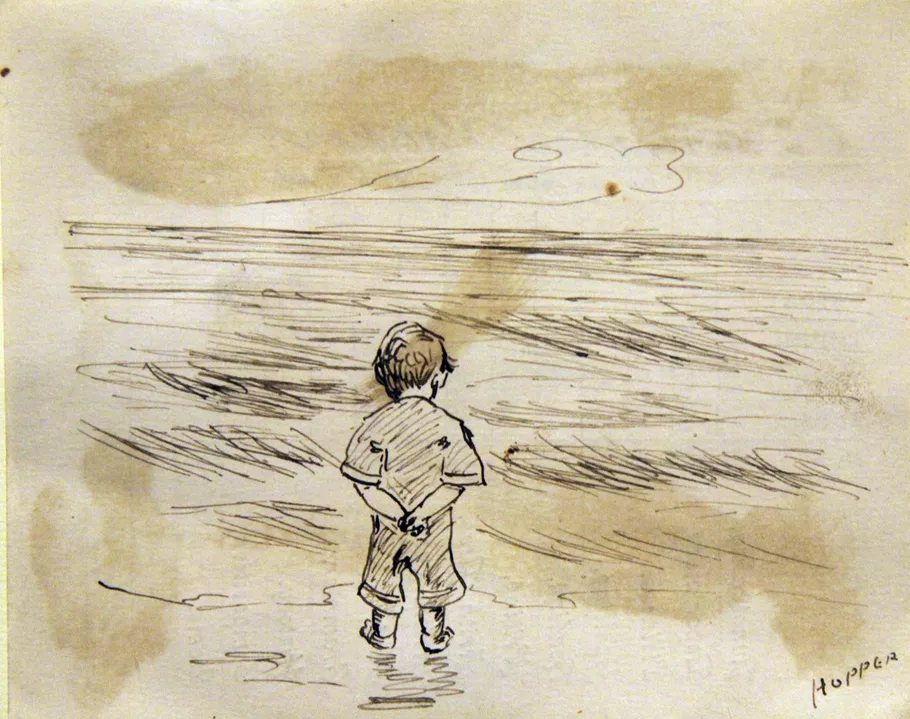
After the event, a friend and I, possessed by sublime curiosity, strolled to the beachfront late in the night. The water was previously adjacent to the coastal road on the Atlantic shoreline. In previous years, if you stretch the neck too long, or stand at the top of giant Victorian towers, you could see the rumbling waves, the city pouring to the beach during festive seasons, spirituality observed by men in white robes, the excitement in the faces of little children building castles with beach sand, lovers holding hands, picking and throwing seashells into the water, naked bodies diving in and out of the waves. But now, the water, sand-filled and rock-filled, lay kilometres and kilometres away. Those times, before the strategic pushback, the city was at the mercy of the water. Its proximity, surging storms, rising tides, the planting of approved and unapproved houses on water channels, and drainage clogged with the city’s filth caused flooding. Although the push back yielded positive results for those around the Victorian Island. However, other neighbouring coastlines express their grief as the ocean currents divert towards their communities. Sometimes, I hear people, terrified by the grandeur of the water and the incomprehensible engineering taming of the coast, express fear about the future rage of the sea and how, one day, it may perish us all.
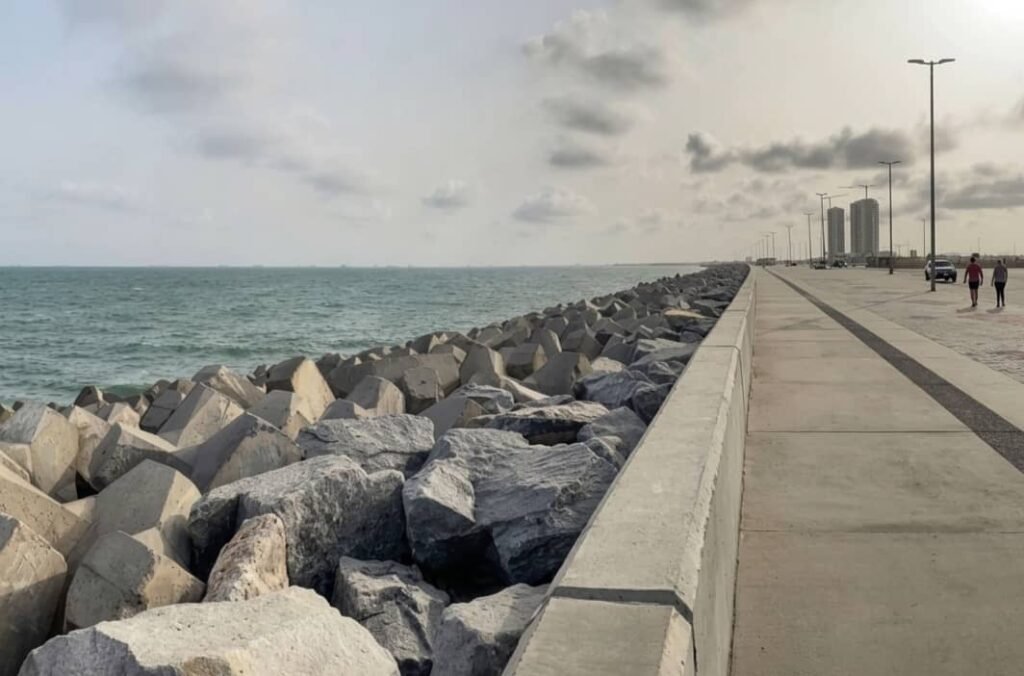
That night, our utter persistence damned the darkness as we walked to the beachfront. Our legs succumbed to necessary fatigue. Eventually, we arrived. Street lights file along the corridors of the beach road. Giant broken rocks heaped at the lip of the water. We sat on “the Great Wall of Lagos”, fencing and protecting the coastline. It was 10.pm or some minutes past. Foreigners smoked and basked in the company of their wives and concubines. Their children, despite late hours, skated with artistic skating boards and shoes. The elderly engaged in, maybe, their routine exercise. Scanty Black men stroll along the walkway. Security vans blare and pierce through the stark silence as street cameras monitor the affairs of men.
I last visited that beach when it still accommodated public affairs. Maybe I was seven or eight. Since then, almost two decades have passed. One lonely noon, it was Eid al-Fitr, I lost hope of going yawo. I, who used to be short and plump, reduced in size as a result of the fast. My younger self, burdened by an utter show of passion and faith, observed the ritual. Maybe I missed one or two days of fasting. Alhamdulillah for those times. Memory fails me when I try to recall what made our house desolate. Was it that my siblings weren’t around? Or did my dad travel? Or was it the same Sallah my grandpa’s death was announced in a fit of sorrow? In vivid pictures, I remember my mum, having cooked and shared the celebration food, lay in her bed. I interrupted her sleep to inform her about the outing with our neighbour, a dark, pretty, slim, and averagely tall Nupe lady. We called her Aunty Kubura. Her family was the reason I knew little about the Tapa people. We lived in communal love, reducing the length of my mother’s contemplations before approval.
I may still wear the same jeans I wore that day, and they would fit so well because it was oversized. Spaces in the white sneakers I wore could contain a tissue pack for both feet if well crushed by the palm. My legs may still sit inside the shoe without inconvenience.
These memories gushed to mind as my friend and I walked the beachfront. We sat there, relishing the vague endlessness of the sea. Staunch darkness sprawled above us and upon the water. Something must be wading upon this sea: water spirits, spirits of our dead. Maybe. At the right extreme, kilometres separated us from the floating ship. Their flashing lights were alive. While sitting, the water crashed many times against giant, broken rocks. The mind pondered on the question, “What if my phone falls below the rock bottom? What if?” In a swift instinct, I pushed my phone deeper into my pocket and placed my hand on it; make no mistake, brother. Make no mistake. Time walked past us without care, as though we came without our minds. As the sea wind blew softness into our tired skin, stories, like the rumbling waves, slapped the past alive. History ran towards me in Broken English, in battered Pidgin. It ran towards the mind as barracoons crammed with slaves. Mirrors. Gins. Chains and whips. Bondsmen. Their masters. Sailors. Slave ship. Middle Passage. Crammed bodies. Putrid sweats. Breathlessness. Sickness. Diseases. Flus. Typhus and Typhoid. Cholera. Smallpox. Scurvy. Tuberculosis. Pneumonia. Malaria. Food poisoning. Mayflower. Jesus of Lubeck. Threnodies. Spirituals. Jazz and souls. Reggae and Blues. Work songs. Code songs. Plantations. Padlocked mouths. Sugarcanes and Cottons.
One night, before bedtime, this experience, in structured contemplation, rose like a ghost after many weeks of my visit. These thoughts inspired a poem, In Search of Triangular History. The world will read it someday. But how do I get over the sufferings of our men across the seas, hundred, and hundred, and hundred, and hundred years ago? I am retraumatised, bearing witness to history. No matter the long years apart, the ocean floor remembers. Even God witnessed the tragedies.
Contributor’s Bio
Olobo Ejile is a Nigerian poet, writer, and researcher. He holds an M.A in Literature from the University of Ibadan. He is a Member of Hilltop Creative Arts Foundation, Lagos Chapter and an alumnus of the 2025 Idembeka Creative Writing Workshop. He is either teaching literature, researching, writing, listening to music, or hustling around the city of Lagos. His works have been longlisted for Wale Okediran Poetry Prize 2025, Ladi Kwali Poetry Prize, among others. He has been published in Shallow Tales,Table Feasting Magazine, Afrocritik, Pepper Coast Magazine, and elsewhere. Connect with him on X @Olobo_Ejile and Olobo Ejie on Facebook.