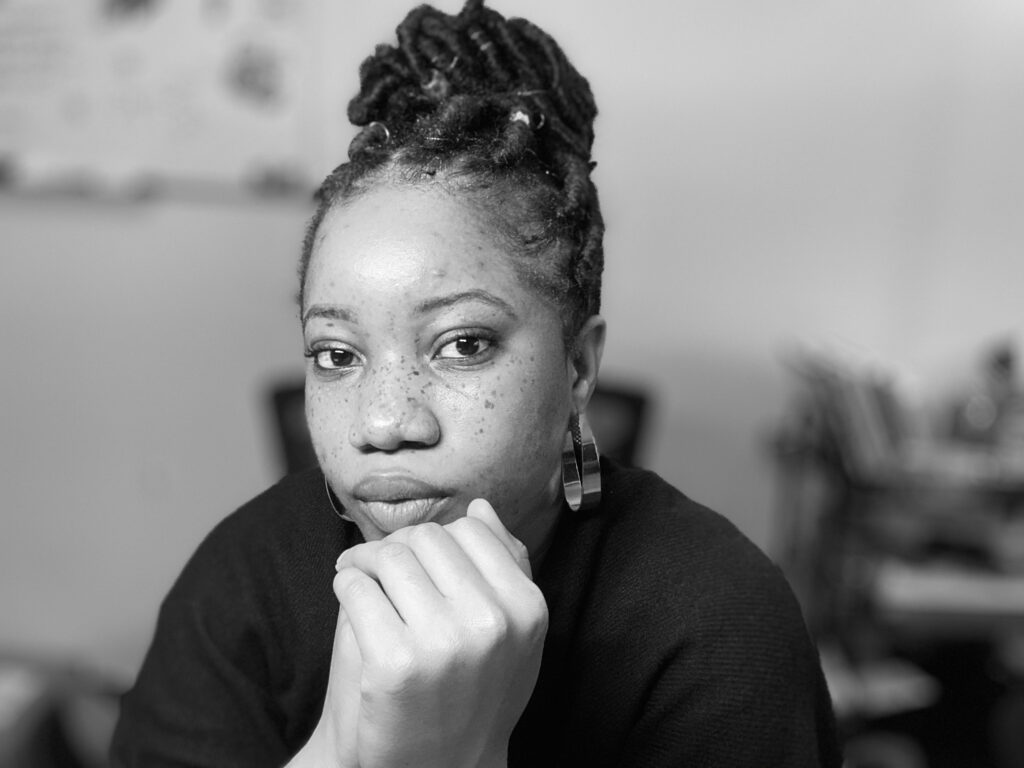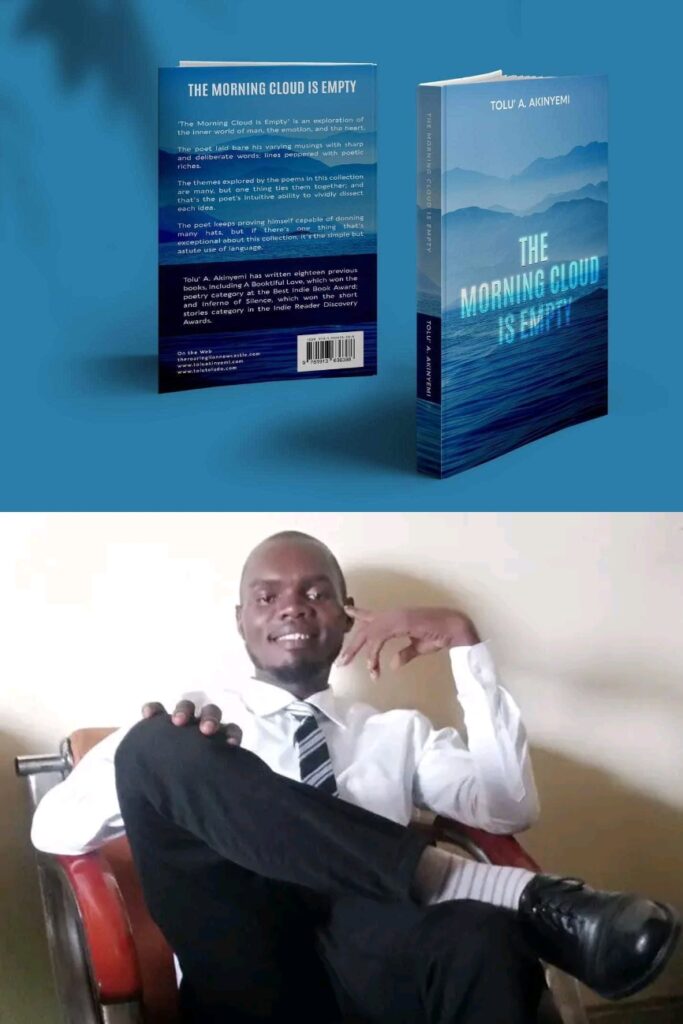
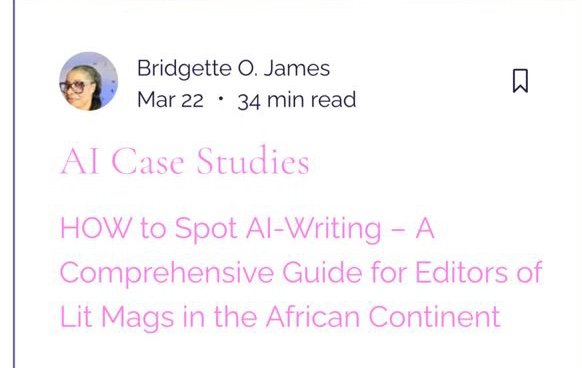
Reading Bridgette James, Reading Me by Oladosu Michael Emerald
“The reader’s dilemma is not so different from the writer who now navigates a community agog with a game of Find the Imposter, where everyone is both player and umpire.” – Innocent Chizaram Ilo on the Ongoing Dilemma for Readers and Writers.
There are few accusations a writer fears today more than being told that the work it took years to learn how to make could have been produced by a machine in seconds. It is an accusation that reaches beyond a single poem. It asks readers to doubt not only your words, but your discipline, your memory, your imagination, and the life that made your writing possible.
For writers from the Global South, that doubt is never entirely new. We inherit a literary history shaped by ideas about whose voices are original, whose brilliance is believable, and whose achievements must first be verified before they are allowed to stand on their own. In an age of artificial intelligence, those old suspicions have found a new language easily.
But I never imagined they would arrive in my life through someone who had first entered it because she admired my work. That is how I remember Bridgette James.
Not as the woman who would one day publish an article suggesting that my brother’s poems, and later one of my own, had been written by artificial intelligence because I refused to accept her accusation that my brother had falsely generated his poem, but as someone who first appeared in my Twitter notifications because she admired something I had written. She was an African-British writer and editor. I was a Nigerian writer who also designed book covers to supplement the uncertain economics of literature. She asked whether I could design one for her. I said yes.
When I delivered the design, she paid me without incident. But our conversations drifted beyond the commission. She told me she admired my writing and encouraged me to submit to an anthology she was editing. The invitation felt generous because she had come into my life through my words, treated them with generosity, and left me with no reason to doubt the sincerity of her admiration.
My younger brother grew up writing alongside me. Like many siblings who discover literature at roughly the same time, our lives became filled with drafts, journals, rejection letters, and impossible ambitions.
We read each other’s work with the kind of honesty only siblings can sometimes afford. We argued over line breaks and titles. We celebrated every acceptance because each one felt improbable. Writing became one of the languages through which we understood each other, even after our paths began to diverge. Eventually, he chose to pursue music instead, earning a degree in Music from the University of Ibadan before building a career in music management. But poetry remained part of who he was, and the poems he wrote belonged to years of reading, revision, and persistence.
Months later, when Bridgette James opened submissions for the Soil Unfurling from Stem poetry competition, I encouraged my younger brother to enter. We often shared opportunities with one another, celebrating publications and prizes with the understanding that, in literature, every submission and platform mattered. He submitted a poem and placed fourth.
The prize was hardly life-changing, ten dollars ($10) in prize money, but he understood that in writing, recognition often arrives long before money does. A publication. A shortlist. A small prize. These become the stepping stones that convince you to keep walking through uncertainty.
Around that same period, Ms. James became increasingly present in my own writing life. She replied to my tweets, complimented my discipline, and praised my commitment to writing. One afternoon, she tagged me and two other writers, offering to pay our submission fees for a competition organized by the Bournemouth Journal. I accepted. I submitted my work, but didn’t place in the winners list, but that hardly mattered. The gesture reinforced what I believed about our relationship: here was someone invested in helping writers find opportunities.
Looking back now, I sometimes wonder whether my memory failed me. I have returned to those early conversations more times than I can count, searching for some overlooked warning, some sentence that hinted at what was to come. I never found one. What I find instead is kindness, encouragement, and the ordinary generosity that makes literary communities feel possible.
The first allegation arrived quietly through an email, or perhaps it was a post in March. The exact form hardly matters now. What matters is that Ms. James accused my brother of submitting an AI-generated poem to the very competition where she had once judged it worthy of fourth place. He denied the allegation immediately, and I believed that would be the beginning of a professional conversation. Instead, it became the beginning of something else.
Before my brother had any meaningful opportunity to respond, Ms. James began posting tweets and recording videos publicly accusing him and another Nigerian writer of using artificial intelligence. His name was no longer attached to a poem or a prize, but to one of the most damaging allegations a writer can face. It was no longer enough to fear rejection. Now we feared disbelief.
I remember staring at my phone, trying to understand what I was witnessing. Was this a misunderstanding that would be resolved through professional conversation, or was it the beginning of something far more dangerous? As writers, we spend years learning to accept criticism and I believe literature depends on mutual trust. Editors trust writers. Writers trust editors. Readers trust that words emerge from human effort, however imperfect.
AI has complicated that trust, but suspicion cannot become its replacement. If accusations require no meaningful evidence, no opportunity to respond, and no accountability when they prove unfounded, then the greatest threat to literature is not artificial intelligence. It is the willingness to abandon fairness in the name of protecting originality.
I kept thinking there had to be another way.
So I wrote to her myself. Before that, my brother had already sent an email that went unanswered in any meaningful way. She maintained her position, insisting that other poets in the Nigerian literary community had also asserted her suspicions. Around the same time, Ms. James tweeted, “these brothers have been very naughty,” and my brother began to question my involvement in the matter.
Editors were supposed to ask questions before making accusations. Writers were supposed to have the opportunity to respond before becoming public examples. Otherwise, the search for truth risked becoming a witch hunt. By then, I had lost confidence in both her methods and her intentions. She had previously written to say she was sorry and that she had no issue with me, that her dispute was with my brother. But the tweets that followed blurred that line. They made it difficult to separate her private assurances from her public conduct.
My email was measured. I acknowledged the anxiety surrounding AI-generated writing. We were all living through it. Every week seemed to bring another story about fabricated essays, machine-written poems, or editors discovering that work they had accepted was not entirely human. The fear was real. But fear, I argued, could not replace evidence. More than anything, I questioned her process.
Why had she not written to my brother privately? Why had she not waited for a response before posting videos and tweets? Why had she quickly chosen public certainty over private conversation? Her reply left little room for discussion. She insisted that she was right. She explained that she had used AI detection software and consulted “experts.” She had carried out her own investigation. Reading her email, I was struck less by the methods she described than by the certainty with which she described them. There was no room for uncertainty, no acknowledgement that AI detection itself had become one of the most disputed technologies in publishing.
What surprised me was that this debate was hardly new. Long before my brother’s case, researchers, editors, and writers had repeatedly warned that AI detection tools were unreliable, particularly when applied to creative writing. They had documented instances in which works written entirely by humans, including texts published years before generative AI existed, were flagged as AI-generated.
It made me wonder what if the same tools were used on Ms. James’ own writing? What if they produced a false positive? Would that result alone be enough to prove that her work was machine-generated? If not, why should the same standard be applied to anyone else? If so, then every writer, regardless of reputation or experience, was vulnerable to the limitations of software that could not distinguish creativity from computation with certainty.
The question was never simply whether the software could produce a result, but whether that result should be treated as proof. In literature, where style, influence, experimentation, and voice often defy predictable patterns, certainty built on an unreliable tool seemed less like evidence than assumption.
This time my email was longer. I challenged the assumptions underlying her conclusions and questioned whether the tools she relied upon could bear the weight she was placing on them. Friends in the literary community told me that perhaps Ms. James had become caught up in the panic surrounding AI submissions. Several magazines had recently discovered allegedly genuinely AI-generated work. Perhaps, they suggested, she had begun seeing certainty where only suspicion existed.
I wanted to believe that explanation. It was easier than believing someone had simply decided so rigidly and completely that a writer was dishonest in their delivery. For a while, our emails continued. But she made sure the accusations continued to be a story unfolding in public while our own attempts to resolve the matter remained private professionally. The imbalance unsettled my brother, friends and I. Public accusations travelled faster than private enquiries ever could. I told Ms. James that if the public statements continued, we would consider legal action. Almost immediately, the tweets disappeared.
Yet again, she informed us in another email that she had contacted the Federal Competition and Consumer Protection Commission (FCCPC) and that the matter had been referred for consideration. We agreed to wait. It seemed, finally, that the dispute might move away from social media and toward something resembling due process.For the first time in weeks, we allowed ourselves to believe that the matter would no longer be tried in the court of public opinion but through the appropriate channels. It felt as though the impulse to publicly condemn had given way to a willingness to let the process take its course. That new consideration did not last.
What happened next taught me that accusations rarely remain where they begin. Instead of ending online, they migrated.
This time, the allegations reached MAAR Review, a young Nigerian literary magazine born out of the Muktar Aliyu Art Residency in Minna. The magazine was not just another publication to me. I had been part of its inaugural residency and later served as an editor for its maiden issue, in which my brother’s poem appeared alongside the work of other writers whose submissions I had helped solicit.
One of the editors, Yahuza Abdullahi, had been a fellow resident with me. I knew him not simply as an editor but as a colleague in a literary community I valued. So when I learned that Ms. James had contacted people connected to the magazine about my brother, I felt something I had not anticipated: first embarrassment, then disappointment. Not because I believed the allegation, but because I could imagine conversations unfolding about my brother’s integrity before he had ever been professionally invited into them.
But this time around, before he was given the opportunity to respond, his poem had already been removed from the magazine’s website. I wrote to Yahuza and asked, why an allegation of that magnitude had been acted upon without first hearing from the writer it concerned. He replied almost immediately. He apologized and explained that the decision had not been his alone. He acknowledged that they should have spoken to my brother before taking action and said they would handle similar professional situations differently in the future.
By then, however, the allegations had already moved beyond literary circles. Ms. James called the Head of Department in the Department of Music at the University of Ibadan directly, alleging that my brother had submitted AI-generated work and had defrauded her. The Head of Department reportedly told her not to contact him again and warned that continued communication of that nature could amount to harassment.
He later contacted my brother because he considered the allegations serious, yet wholly inconsistent with the student and person he had come to know. My brother had only recently graduated. When he called me afterwards, there was something in his voice I had never heard before. It was not anger nor disbelief. It was the exhaustion of someone beginning to understand that an accusation, once released into the world, does not necessarily end when it is answered. Sometimes it finds another place to begin again.
That was when I realized this was no longer about a single allegation or a disagreement over a poem. It had become a pattern. Wherever my brother had built community or earned trust, the accusation seemed to arrive before him, leaving a trail for him to walk through long after it had been made. It worried me, and it worried some of my writer friends, how far someone like this was willing to go without sufficient evidence. We began to ask ourselves questions. Has Ms. James gone to these same lengths with other writers? Or was my brother simply the means to an end, a convenient target whose public accusation could bolster her credibility within the Nigerian literary community? Was my own credibility as a writer, and the standing I had built in the literary community, the real motivation behind the relentless pursuit of him? Or was she yet another ardent “AI-player-umpire?”
Then, almost absurdly, the dispute became about ten dollars. After everything that had happened, the tweets, the emails, the conversations with literary magazines, and the contact with my brother’s university, Bridgette wrote demanding that my brother donate the ten-dollar prize money he had received to a charity of her choosing in Nigeria.
By then, some of my writer friends felt we had been taken through an emotional rollercoaster. What had started as an allegation no longer seemed aimed at resolving a dispute but had begun to resemble a witch hunt. Friends occasionally brought the situation back into conversation. They had followed the tweets before they disappeared. They had watched the allegations spread from one platform to another, and more than one person remarked that what had begun as a disagreement no longer resembled one. It resembled fixation. Another writer had initially been mentioned alongside my brother, yet the intensity increasingly seemed reserved almost entirely for him. It became difficult to ignore the imbalance.
My brother continued to insist, as he always had, that the poem was entirely his. But we wanted the ordeal to end. If donating the ten-dollar prize money to a charity of Ms. James’ choosing would finally resolve the matter, then we were willing to do it. Ten dollars was insignificant compared to the weeks of accusations, emails, and public scrutiny. We believed we were making a final concession so that everyone could move on.
Months passed, but no charity was ever named. No follow-up email arrived. The request simply dissolved into silence, as though it had never truly been about anything at all. Like most writers I know, I returned to the familiar cycle of projects, fellowships, editorial work, applications, and my brother continued his new life in Lagos.
Months after the silence had settled between us, another email arrived. On the morning of Wednesday, June 24, Ms. James copied both my brother and me into it. The opening line was not conciliatory or procedural. It was a taunt: “Please Do Not Reply if Blind Copied” assumed, at first, that the article addressed the wider debate surrounding artificial intelligence in literature.
After months of emails, accusations and failed attempts at resolution, I thought perhaps she had turned from our correspondence to the broader questions it had raised. But when I clicked the link, I saw myself. Not my full name, but my initials, and my brother’s “MEO and DJO”. Beside them were enough details that anyone familiar with the events could identify both my brother and me without difficulty.
As I continued reading, I realized this was no longer a dispute confined to my brother. One of the poems presented as an example of AI-generated writing was mine. It was the same poem Ms. James had personally invited me to submit. The same poem she had accepted for publication after corresponding with me about my work.
It is difficult to describe the experience of reading someone else’s reconstruction of your own creative process. The emails had not disappeared. But what had changed was not the record of those interactions but the stories now being built around them. What unsettled me most was not simply the allegation that the poem had been generated by artificial intelligence. It was that I remembered writing it with precision because I had been solicited personally. It is also significant that Ms. James herself had nominated the poem for Poem of the Month in September 2025.
The article then took an expected turn to no surprise to my friends. Ms. James explained that every writer discussed in her study came from the same African country. Two of them, she noted, were brothers. One of those brothers, she added, had recently received admission to an American university before assuring readers there were “no sinister reasons” for writing the article. My admission to the University of Mississippi had no connection to the authorship of a poem. It had no connection to AI detection. Yet it had become part of the article’s centre. It was the result of years of academic work, writing, editing, fellowships, community engagement, and a body of literary and educational contributions that existed long before this dispute. My application was evaluated on its own merits, through an admissions process entirely independent of a single poem or the controversy that later surrounded it.
That is why the inclusion of my admission was so troubling. It transformed an unrelated accomplishment into part of a narrative of alleged misconduct, inviting scrutiny of something that had never been in issue. Whatever its intention, I am not naive enough to not understand the reason was to cast doubt on an achievement that I had earned entirely on its own merits.
Only a few months earlier, I had celebrated that admission as the culmination of years spent writing through uncertainty: unsuccessful applications, unpublished drafts, and the gradual formation of a literary community that had sustained me long before any formal recognition arrived. The admission had felt less like a reward than permission to believe that those years had mattered.
Reading the article changed that feeling almost immediately. I found myself wondering how editors encountering my work might read it differently. Whether colleagues would come across my initials beside allegations of AI-generated writing. Whether the professional relationships I had spent years building might now require quiet explanations.
A writer’s reputation is rarely built through a single publication. It accumulates slowly through editors, mentors, readers and fellow writers who choose, repeatedly, to trust your work. That is why the article felt larger than a disagreement over one poem and what I can confidently describe as a witch-hunt and cyber bullying.
Every piece of writing I have published bears the influence of conversations with other people: editors who challenged my drafts, friends who read unfinished work, older writers who introduced me to new traditions, and communities that made writing feel less solitary than it often appears.To question the authorship of a poem is one thing. To publicly suggest that years of work, revision and editorial engagement can be explained by artificial intelligence is something else entirely.
Only weeks before, a master’s student had written asking permission to use my work to train an AI model for her thesis. I declined without hesitation. I have always believed that writers should have the right to decide how their work enters technological systems. Yet now I was confronted with the possibility that my own poems had been uploaded into AI detection software without my knowledge, transformed into evidence against me in a process I had never agreed to participate in. The irony was impossible to ignore. I had refused to let AI learn from my work; now AI was being asked to testify against it in a hit piece.
What remains most difficult to reconcile is not simply the accusation itself, but its methods and source. What had started as a disagreement over a poem’s originality had expanded steadily outward. It had moved from private emails to public posts, from questions about my brother’s work to questions about mine, from conversations between individuals to communications with literary magazines, editors, my brother’s university and, eventually, an article that invited the wider literary community into the dispute. The accusation was no longer confined to the poem that had prompted the original complaint. It had become attached to our names, my name and the sudden inclusion is even a clearer intent of a witch hunt.
Disagreement is an inevitable part of literary culture. Writers challenge one another’s ideas. Editors reject work. Critics question interpretations. Even accusations of misconduct, when supported by evidence and handled through appropriate processes, have their place.
What concerned me was something different. Each time we believed the matter had reached its conclusion, another public escalation followed. After attempts at private correspondence came social media. After social media came contact with institutions. After institutions came an article identifying us through details that made anonymity largely meaningless. Even after we agreed to donate the prize money my brother had received, not as an admission of wrongdoing but in the hope of ending the conflict, the dispute did not end.
It simply found another form. Looking back, I realized that resolution never seemed to be the objective. Every attempt to close the matter was followed by another reopening of it. That was the point at which I began thinking less about artificial intelligence and more about the nature of public accusation itself, and what it emboldens.
The internet has made it remarkably easy for disagreements to become permanent public records. A search result can outlive a clarification. An allegation can travel farther than a correction. Even when readers remain uncertain about the facts, uncertainty itself can alter how a writer is perceived. For writers, reputation is part of our professional currency. We rely on trust, trust in our integrity, our originality and our professionalism. Once that trust is publicly questioned, the burden often shifts to the accused to prove a negative.
How does a writer prove that they wrote what they remember writing? By breaking down Bridgette James’ AI-detection tools findings? By questioning her expert consultants? Or questioning the assertions of the unnamed Nigerian poets of her accusations towards us? That is why I found the experience so unsettling. It was not simply that my work had been questioned. It was that the questioning itself had become increasingly public, increasingly malicious, increasingly personal and increasingly difficult to escape.
When I first entered the literary world, I believed a writer’s greatest vulnerability was rejection. I thought the hardest part would be producing work that editors declined or readers ignored. I never imagined that one day I would find myself defending not only a poem but the fact that I had written it at all.
Artificial intelligence has undoubtedly changed literature. Editors will continue to ask difficult questions, and writers will continue to navigate new technologies whose consequences we are only beginning to understand. Those conversations are necessary. They deserve careful evidence, intellectual honesty and, above all, fairness.
What they cannot survive is the substitution of suspicion for proof.
Looking back, I think less about the poem than about what the months surrounding it revealed. They revealed how quickly trust can fracture, how easily a reputation built over years can become entangled in public allegations, and how difficult it is to reclaim a narrative once someone else begins telling it for you. And no public accusation can erase the years of work, community and conviction from which my hard work has been built on.
Perhaps that is the lesson I leave with.
The future of literature will not be determined only by what artificial intelligence can produce. It will also be determined by how willing we are to treat one another with fairness when questions arise, how carefully we distinguish evidence from assumption, and whether we can protect both the integrity of our work and the dignity of the people who create it. I never expected artificial intelligence to become part of my literary story.
I certainly never expected it to arrive through someone who first entered my life because she admired my writing.
This essay is my attempt to place on record not simply what happened, but what it felt like to live through it. Beyond the emails, the articles and the allegations, there remains something no accusation has taken from me: the certainty that I know the work I have made, the life that shaped it, and the writer I have spent years becoming.
After reading the article, I asked that it be withdrawn and that an apology be issued within forty-eight hours. That request was refused. The article remains online. At that point, I concluded that the matter could no longer be resolved through private correspondence. The issues raised by the publication, including the allegations made about my work and the reputational harm I believe they have caused, are now matters I intend to pursue through the appropriate legal channels. It is a course of action that, throughout her campaign, Ms. James never appeared to consider. If the objective was accountability, the appropriate avenues were always available. Instead, what followed was a prolonged public smear campaign that expanded from allegations against my brother to attacks on my own work and reputation.
What remains unclear is what Bridgette James actually wants as of June 25, 2026. Is the goal to rally readers into picking up their pitchforks against my brother and me until we finally confess to something we did not do? If so, it is a confession she will never receive. The truth does not change simply because the demands do.
At this point, I would be lying, or perhaps we all would, if I claimed to not understand what Bridgette James has been trying to achieve. Most recently, The redacted press, with whom I had already signed a publishing contract, completed edits, and finalized publication plans for a forthcoming poem, has written to me citing AI detection concerns. This is despite the fact that they had previously sent me an honorarium as a goodwill payment toward my GoFundMe ahead of the publication date. Yet now, after all edits had been completed and publication finalized, an AI detection allegation has been raised against a poem that had already gone through their editorial process. They have also requested that I repay the honorarium by July 20.
As of June 25, 2026, this does not remain the greatest mystery of this entire affair. The greater mystery is why allegations founded on AI detection tools, unnamed experts, and unnamed writers have repeatedly been treated as sufficient to disrupt careers, question reputations, and influence editorial decisions, while the methods behind those allegations remain largely undisclosed. If accusations can travel this far, affecting publishers, literary magazines, and contracts already in place, then surely the standards of evidence should be at least as rigorous as the consequences they produce.
That conversation is long overdue.
PS: The redacted Press had, however, quickly resolved the issue, and the poem will now be published as planned.
Contributor’s Bio
Oladosu Michael Emerald is a writer, artist, photographer, and actor. He is the author of “Every Little Thing That Moves” and serves as an editor at Uncanny Magazine, and Surging Tide. A Science Fiction and Fantasy Poetry Association member. A 3X Best of the Net nominee, 3X Pushcart nominee, he is the winner of the Sine Qua Non Inaugural Poetry Prize (2025), Stephen DiBiase Poetry Prize (2026), Off the Limit Contest (2023), SprinNG Poetry Contest (2024), Garden Party Collective Neurodivergent Poetry Contest (2025), and first-runner-up of Sande Poetry Prize (2025). His work has appeared or is forthcoming in Chestnut Review, FIYAH, ONLY POEMS, Asimov, Bournemouth Journal, Temz Review, and elsewhere.
He is a pioneer resident of the Muktar Aliyu Art Residency and the Rongo Art Residency, and a fellow of The Ugly Collective. He tweets @garricologist on X and @oladosu_michael_emerald on Instagram.