The Cathartic Frequency in the Muse Behind Poetry: A Review of Olowo Qudus’ “A Black Bird Sings About Loss”
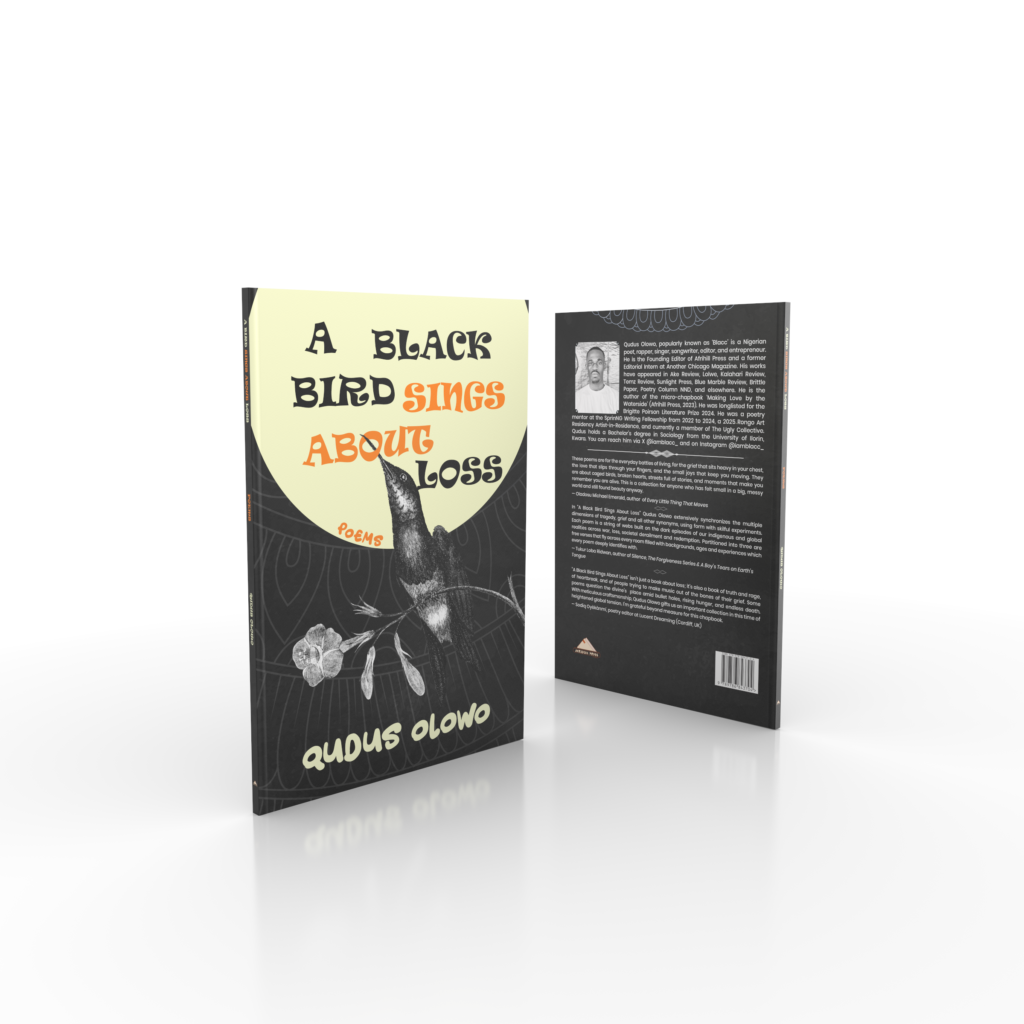
When I first came across Qudus Olowo’s most recent collection, a few interpretations coursed through my mind for each word that constitutes the book’s title. The symbolism of race by the word “black” coincides with the migratory trajectory of a bird, especially in this part of the world where our skin is looking to bask offshore.
While “sing” establishes the lyricism of poetry, “loss” is positioned as the object and accompanying theme of the author’s identity as “a black bird”. What I appreciate about the title alone is how these words invite you into the dark layers of the author’s bird’s-eye view of his society.
Particularly, the clash between the suspension of hope and the acceptance of tragedy in all shapes and forms. While the subject matter across every poem has been a recurring source of lamentation in the Nigerian literary, sociopolitical, and economic landscape, Qudus Olowo puts a technical spin on this elegiac outpouring through judicious experimentation with form.
This adds, in no small measure, to the variety that makes poetry pleasing to the eyes, as a work of art, not to mention the demarcation of “loss” into three folds, as would chapters to a novel. This partition, at least, gave me the room to pause, like a speed bump, before I ran into further calamities that every literal lamentation comes with.
The first loss of eight poems opens with the thin line between the morning and mourning, as a testament to the double-edged sword that existence could be. The “place” in the first poem witnesses the jostle for rhythm between the “muezzin’s sacred voice” and the “bullets’ purrs” (Line 2 of How We Begin Out Mo[u]rning).
The poet further justifies this dichotomy with a common destination, God (Line 3). While the poet establishes the two ways to meet this divine entity, the poem subtly exposes the sad reality underlying the daytime journey of survival, either through faith or through fate.
However, these two alternatives could collide into what we hear of insurgencies in Nigeria: Gunshots ravaging the faithful in their worship houses. The excellent attempt at dualism throughout the poem narrows down to a daring evaluation of the idea of godhood, as God could be a “butterfly” or a “bedbug” (Line 10).
In Home and Every Police Bullet Serving Its Purpose, the author reminds us of what a morning in Ibadan could look like, with an empirical reference from a 2025 Investigative Journalism report. The weight of this poem is the bodies as “specimens” to the infamous “police AK47”, capable of stray shots that spare no one, capable of sending a schoolchild to the “news bulletin of daily tragedies”.
The semantics of “justice” take a different implication from what we expect of a system that protects a select few by slapping an errant officer on the wrist. The author points to a Quranic verse as the breakfast of a Muslim faithful for protection from “bullet ulcer”, similar to what occurs in Self Portrait of a Boy Beating His Tasbeeh into Supplications:
“Lailahilallah…
Astaghfirullah…
Alhamdullilah”.
(Lines 5, 17, and 23).
In contrast, this expression “do not read the Bible or the Quran before leaving—prayers are denied boarding passes” in A Syntax on How to Have a Safe Train Trip in My Country raises the question of the absolute efficacy of spiritual supplication in critical times, especially when the security of lives is relegated to the government’s priority list.
When prayer, a spiritual thrust into the abstract, becomes a close substitute for the practicality of administrative responsibilities, it’s only a matter of circumstance that this coveted ritual is demystified and considered ineffective when bullets arrive “ahead of the breeze” or when demons waylay to “devour your bodies”. Therefore, the poet suggests a rather intuitive grasp of and response to ambush, urging us to (not) trust our gut:
“Listen to the voices in your head;
They teach you about survival.
If the voices tell you to run, do not.
If they tell you to stay, run.
(Line 13 – 14).
The same texture of mortal fear runs through Nowadays, When I Read a Sudanese Poem, to attest to the experience of terror beyond our geography. This is where “war” becomes the unspoken “language of peace…written with blood on the hand”. The metaphor of bullets as “unwanted bones choking the larynx” is one of the subject matters of inhumanity in a war-torn society.
This poem exposes the decimation of the idea of peace by reminding us of how common war is in our ecosystem, the same reason why “an egret dashes into the turquoise clouds” and why “you flee into darkness, when guns and grenades spoke the language of the potter’s field” in Flight.
Hence, the worst-case scenario is the evacuation of one’s home, as if that’s what “black” birds do, to be able to sing about loss. Psychologically, this is a trauma response called “flight” to the sound of war, reminiscent of the poem on migration, Home is in the Mouth of a Shark by Warsan Shire.
The author, being a Social Scientist by discipline, also extends his concern to our socio-economic travails and the impact of such on our humanity in Country’s Equation: Rise of Dollar Equals the Rise of Hunger and Sorry, I Didn’t Call You Back.
Interestingly, a common discovery for me in these two poems is similar expressions that hint at self-preservation in times of extreme scarcity:
“I watched closely from my window, wishing I could stint on my last tin of Garri. But if I do, then my funeral is close to home”, and “my neighbour knocks at my door to ask if I have leftover meals for her dying son. How can I tell her I’m dying of hunger too?”, in the two aforementioned poems, respectively.
What these poems do is remind us of the real cost of our humanity, which we tend to profess without contextualizing the conditions likely to test our sacrificial resolve. If you’d likely die from starvation, would you give your last meal to someone in the same vulnerable position? That’s my question as a test of our self-professed righteousness.
While these two poems are a realistic exposition of poverty through precise storytelling, other poems like And We Shall Rise into a Beautiful Revolution are the most transparent review of our political setback as a race. This is where form becomes the rising tide of a poem that moves from the bottom to the top, an illustration of the word “rise”.
But then, what exactly are we rising into? The visual elevation in this poem takes us through the Orwellian organogram of the country’s political structure, particularly showing us the simple trick to longevity: Silence. In other words, we’re learning to stay alive by not speaking to power in the face of injustice, oppression, indifference to insecurity, and wanton economic crisis.
On the other hand, the same silence, according to the author, was the beginning of our descent into this historical abyss:
“…but do silence not kill too?
Remember how our progenitors’ lips were locked,
Their home songs paused until they forgot
What their home sounds like.”
(Lines 11 – 14, bottom to top).
In addition, the poet asks, “How long before a caged bird tastes the beauty of freedom?… freedom sometimes is a curse, you jolly carelessly into the world, forgetting ruin owns a room in every place”.
It gets worse with every journey to the top of the poem, considering our learned numbness and helplessness as a people: “How do we escape the fire burning our homes? First, we dispose of the matchsticks until we feel no spark to live.”
Another experimental product of Qudus’ genius is the last of the first loss, Outside the Box Redemption, in which the self-explanatory title tells us how our survival requires that the history of self-hate, surrender, and slavery to foreign conquest be not repeated.
In a nutshell, we have to “learn how to swim” to avoid sinking like the memories of our “progenitors’ drowned bodies”. “Don’t forget the memories” is repeated for effect because “to forget is to forget home or the ruin… to forget your history burning on the tide’s tongue”.
Another repetition is to “fight” both “the ship” and “the foreign sailor” because “your fathers have drowned enough”. The ultimate goal is to “not die in vain… in the water like your fathers”. Another repetitive pointer is the lyrically elaborate poem “Sing. Sing”, which provokes our memories and desires for a change in the second fold of loss.
Olowo Qudus takes this form of experimentation a notch higher with S p l I t Decisions and My Tutor’s Time Table on Living to create a precise collage for the different shades of hope, conflict and despair. His Hallucinations is a surreal thrust of survival, using dreams and abstractions. An Excuse for Not Returning the Visit of a Friend is an apology of a migrant in a “life still learning its shape”.
While the anthems of loss and grief continue through a banquet of twenty-four thorns of poems, the “Third Loss” ends with three emotive poems on love and forlorn, being the shortest segment of the collection. One of the poems is a demonstration of the author’s storytelling skills in Calligraphy of a Valentine’s Night.
Other poems such as And My Cup Runneth Over, A Night Around Somewhere in Lagos Island and Ibadan Does Not Know Your Father’s Name are the least of Olowo Qudus’ immersive musings, giving this meticulous collection a seamless flow throughout the fragments of a bleak reality underlining the author’s practical view of an ailing world.
Contributor’s Bio
Tukur Ridwan is a Nigerian author of three poetry chapbooks, a literary reviewer, a mobile photographer, and a Political Science graduate from UNILORIN.
A recipient of the Brigitte Poirson Monthly Poetry Contest (March 2018) and a poetry mentor at SprinNG Writing Fellowship, Tukur’s works appear in Afrihill Press, Afrocritik, Aké Review, The Argyle, Barzakh, Cordite, Engendered, Kalahari, Prosetrics, Rising Phoenix, Stripes, and elsewhere.
His poems were shortlisted in the Collins Elesiro Poetry Contest (2019), the Eriata Oribhabor Poetry Prize (2020), and the Bridgette James Poetry Competition (2025). They were also featured in art exhibitions by Prince Saheed Adelakun (2024 & 2026).
He loves black tea, sometimes coffee. X and IG @Oreal2kur